Cart
0
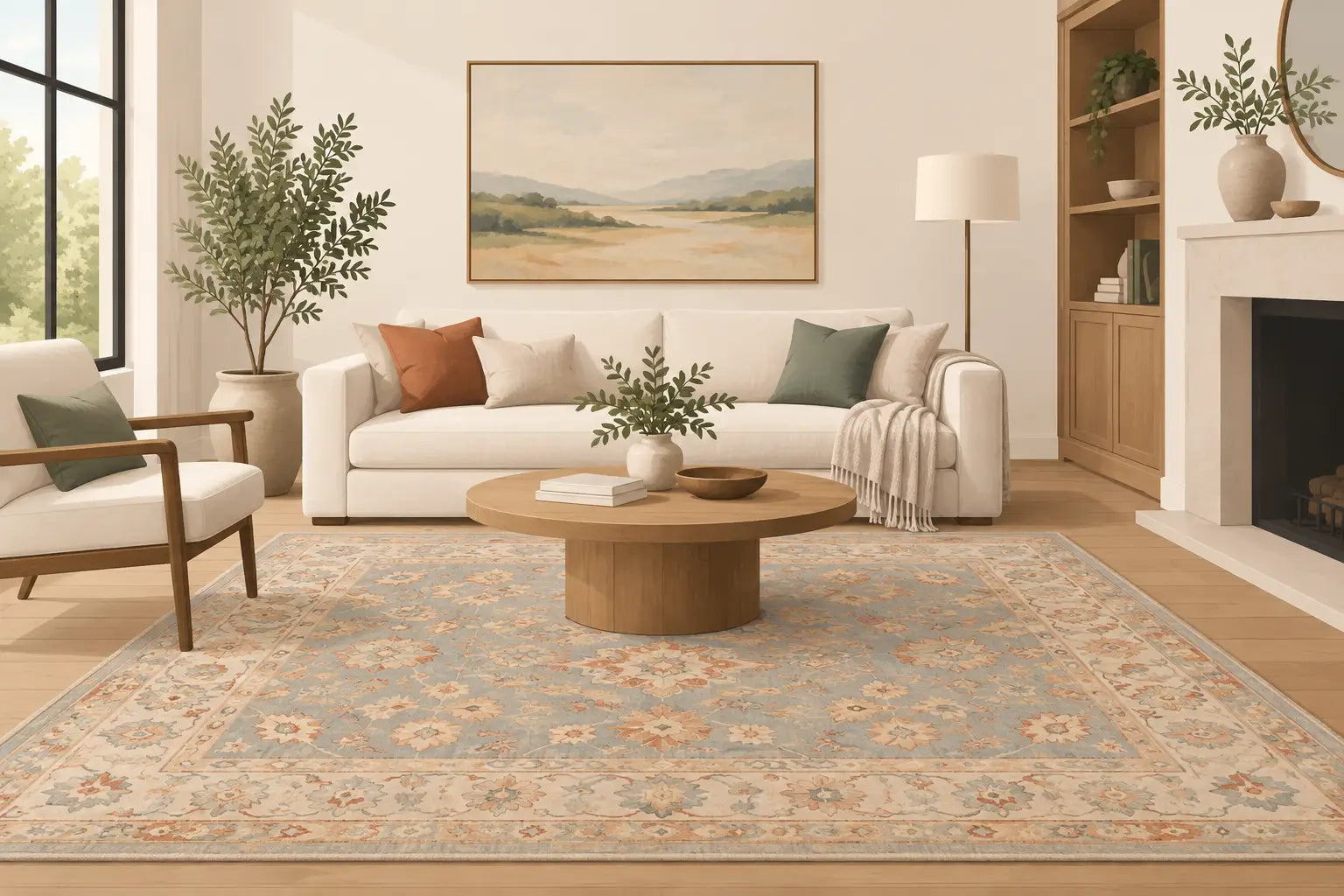
A beautiful Oushak does more than fill an empty patch of floor. The best Oushak rug living room ideas use its soft color, generous scale, and hand-knotted texture to give the whole room a settled, collected feeling. Whether your home leans traditional, modern, coastal, or somewhere comfortably in between, an authentic wool Oushak can be the piece that makes separate furnishings feel intentionally chosen.
Oushak rugs have a particular ease in living rooms because their patterns are detailed without usually feeling busy. Originating from a Turkish weaving tradition, they are known for open floral motifs, spacious fields, and softened palettes that can include warm ivory, faded blue, sage, blush, gold, terracotta, and gentle brown. That visual breathing room makes them remarkably flexible, but the right size and placement still matter more than any single color choice.
Start With the Rug Size, Not the Empty Floor
A living room rug should relate to the seating arrangement, not simply sit in the center of the room like an island. In most spaces, an Oushak looks most convincing when it is large enough to anchor the furniture and show off its design.
For a standard living room, an 8 x 10 or 9 x 12 rug is often the most useful starting point. Aim to place at least the front legs of the sofa and chairs on the rug. This connects the pieces visually and creates a conversation area rather than a collection of furniture pushed against the walls.
In a generous room with a long sofa, multiple chairs, or two seating zones, a 10 x 14 may be the better choice. A larger rug is not wasted space. It allows the pattern to read properly, gives furniture room to breathe, and makes the room feel more finished. Oushak designs are especially well suited to larger formats because their broad motifs remain graceful at scale.
A smaller rug can work in a compact apartment or a room with a clearly defined sofa-and-chair grouping. Just avoid a common mistake: choosing a 5 x 8 rug for a full-sized living room because it appears less expensive or easier to manage. It can make even beautiful furniture look disconnected. If your budget has a ceiling, it is often better to simplify elsewhere and select the most appropriate rug size for the layout.
Oushak Rug Living Room Ideas by Color Direction
An Oushak can lead the palette or quietly support it. The right approach depends on whether your existing furnishings are neutral, colorful, formal, or relaxed.
Build a warm neutral room around ivory and beige
An ivory, sand, or light beige Oushak brings warmth that a plain cream rug often cannot. Its subtle variation keeps a neutral room from looking flat, particularly alongside linen upholstery, oak furniture, plaster walls, and woven window treatments.
Choose a rug with accents of camel, faded gold, soft gray, or muted taupe, then repeat only one or two of those tones in pillows, a throw, or a small ceramic detail. You do not need to match every color in the rug. A handmade rug is meant to feel layered, not coordinated down to the last thread.
This approach works especially well for homeowners who want a light-filled living room but still need a floor covering that feels practical and forgiving. Natural wool has visual depth, and a gently patterned field is typically more accommodating than a solid pale rug in an active household.
Add calm color with blue, green, or faded rose
A blue Oushak can make a room feel cooler and more tailored without creating the formality of a navy geometric rug. Pair a powder-blue or denim-toned design with cream seating, walnut tables, antique brass, and warm white walls. The mix is classic but not stiff.
Soft sage and celadon Oushaks are equally useful in rooms with wood, leather, or black metal. They bring an organic note to contemporary spaces, while their traditional pattern prevents the room from becoming too minimal. A faded rose or peachy Oushak is lovely with darker woods and chocolate brown accents, especially if you want warmth without relying on bright red.
The trade-off is that pastel rugs can change character with the light. Before choosing one, consider the room's daylight, wall color, and dominant upholstery. A pale blue that feels airy in a sunlit room may look more gray in a north-facing space.
Let a richer Oushak ground pale upholstery
If the sofa is white, ivory, or light gray, a more saturated Oushak can provide needed contrast. Look for terracotta, cinnamon, rust, deep denim, or layered brown details in the design. These colors make pale seating feel intentional and are particularly effective in rooms with high ceilings or large expanses of neutral wall.
Keep the surrounding pattern mix measured. A floral Oushak can sit beautifully with striped pillows or a small-scale print, but avoid competing with another large, ornate pattern on drapery or upholstered chairs. Let the rug carry the broadest pattern, then use solids and quieter textures nearby.
Mix Old-World Pattern With Modern Furniture
One of the most appealing ways to use an Oushak is to place it under furniture that is not traditional at all. A low-profile sectional, sculptural coffee table, clean-lined swivel chairs, or contemporary lighting can look more inviting when grounded by a hand-knotted Turkish rug.
The contrast works because an Oushak introduces age, texture, and human variation. Modern furnishings can otherwise feel crisp to the point of being impersonal. In return, the cleaner furniture shapes keep the rug from making the room feel overly formal or themed.
For a balanced look, repeat the rug's warmth in one or two materials: a wood side table, aged brass lamp, leather accent chair, or woven shade. This is enough to create continuity. Filling the room with carved furniture, ornate mirrors, and heavily patterned fabric can turn a graceful Oushak into part of a period set rather than a living space that reflects you.
Use the Rug to Define an Open-Plan Living Room
Open layouts benefit from a clear visual boundary, especially when the living area shares space with a kitchen or dining room. A large Oushak gives the seating zone definition without requiring a wall or divider.
Center the rug on the main seating group rather than the entire open room. The sofa, chairs, coffee table, and front feet of key pieces should sit within its perimeter. If the sofa floats in the room, leave a consistent border of visible floor around the rug so the arrangement feels deliberate.
An Oushak is also a smart choice where the kitchen has hard, sleek finishes. Its wool texture and softened pattern counterbalance stone counters, painted cabinetry, and metal fixtures. If the adjacent dining area needs a rug as well, do not feel pressured to match it exactly. Choose a complementary rug with a quieter design or related colors so each zone has its own identity.
Layer Texture Carefully in Casual Rooms
For a relaxed family room, an Oushak can make casual pieces feel elevated without making the room precious. Think slipcovered seating, a deep upholstered sofa, a leather ottoman, and baskets or wood accents. The rug brings refinement, while the rest of the room keeps it approachable.
Avoid layering a large patterned Oushak over another patterned rug. If you want additional softness, use a proper rug pad underneath rather than adding visual clutter on top. A quality pad improves comfort underfoot, helps the rug lie smoothly, and can reduce wear from furniture movement.
For rooms with pets, children, or frequent entertaining, look beyond the idea that an authentic hand-knotted wool rug must be saved for a formal space. Wool is naturally resilient, and the nuanced color variation of many Oushaks is more forgiving than a flat, solid-color floor covering. Still, a very pale rug in a high-traffic path will require more regular care than a design with deeper color and stronger pattern.
Make the Coffee Table Part of the Composition
A coffee table should reveal, not obscure, the best of the rug. Glass and open-base tables let more of the Oushak design remain visible, while wood tables add warmth and work beautifully when their finish relates to one of the rug's quieter tones.
With a substantial upholstered ottoman, choose a rug large enough that the ottoman does not consume its center. A hand-knotted rug deserves some visible field around the table, particularly if it has a striking medallion or a spacious floral pattern. In a room where the rug is the main artwork, keeping the tabletop styling simple lets that artistry do its work.
A thoughtfully chosen Oushak does not need to match every pillow, paint color, or piece of wood in the room. Give it enough scale, let its handwoven character show, and allow the rest of the living room to respond to it naturally. That is often where a beautiful space begins to feel like a home.