Cart
0
Your entryway rug has one job before anything else: make the threshold feel intentional. A beautiful handmade rug can bring warmth, color, and personality to a space that is often all hard surfaces and straight lines, but even a stunning design will feel misplaced if it is too small, too wide, or caught beneath the door. Knowing how to size an entryway rug begins with the architecture of your home, not a standard rug chart.
How to Size an Entryway Rug: Start With the Floor
Measure the open floor area of the entry, then measure again with the front door fully open. This second measurement matters more than many shoppers expect. If your door swings inward, the rug needs enough clearance to lie flat without folding, catching, or creating an awkward stop point for the door.
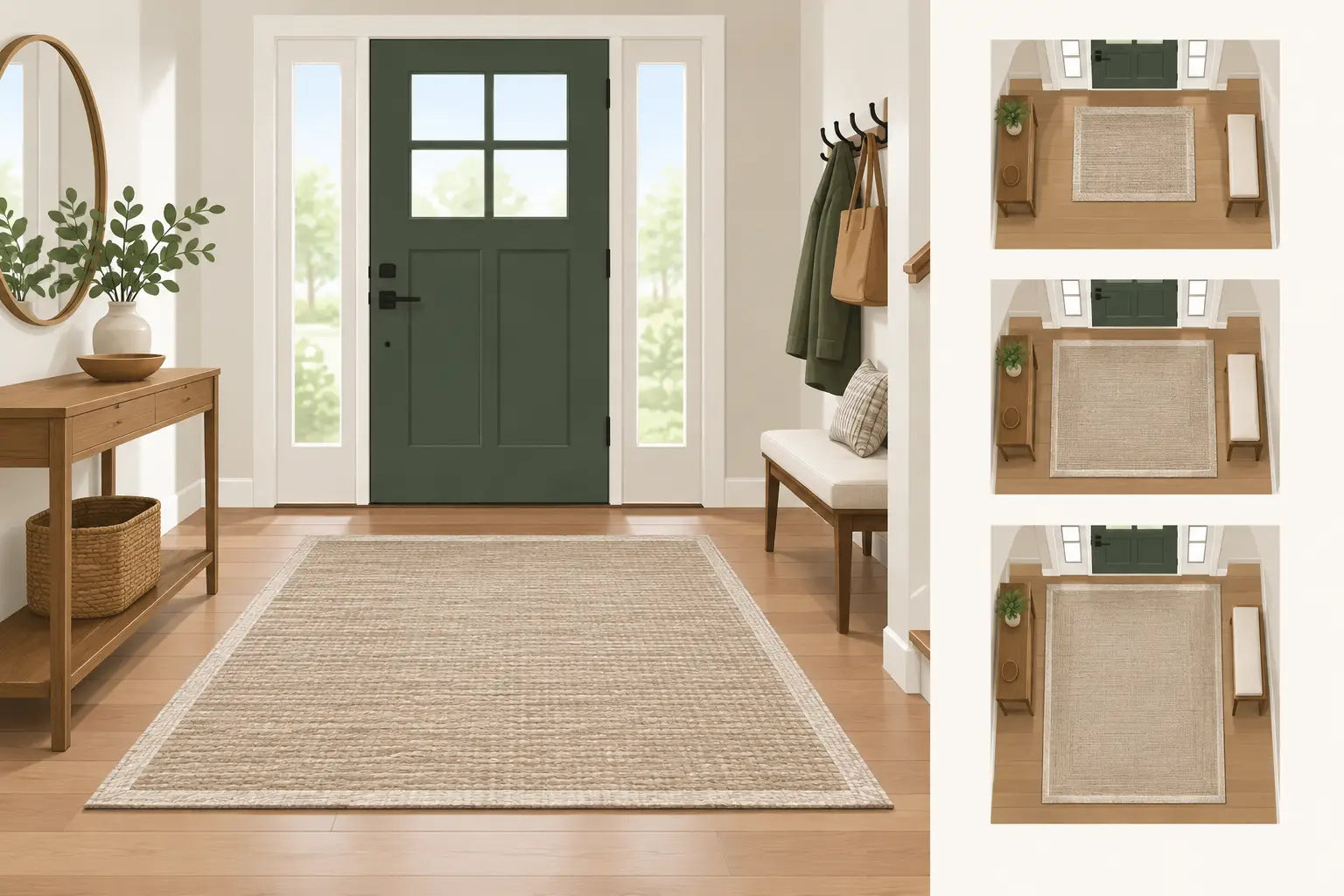
In a typical entry, aim to leave a visible border of flooring around the rug. Four to eight inches on each side often looks balanced in a compact foyer, while a larger entry can handle eight to 12 inches of exposed floor. Those borders do not need to be mathematically identical if walls, stairs, or a closet door make the space asymmetrical. What matters is that the rug looks centered within the area people experience as the entry.
Avoid sizing a rug only to the width of the front door. A rug that is nearly as narrow as the door can look like a temporary mat rather than a considered part of the room. Let the rug extend beyond the door frame where space allows, especially when the entry opens into a wider hall or living area.
Before purchasing, use painter's tape to outline the prospective size on the floor. Open every nearby door, walk through the space with a bag in hand, and stand at the front door looking in. This simple step reveals whether the rug feels generous, whether it interrupts a traffic path, and whether its proportions support the rest of the home.
Match Common Entryway Rug Sizes to Your Layout
There is no single correct entry rug size, but several formats work reliably when they match the scale of the space.
A 2 x 3 rug is best for a very compact entry, an apartment landing, or the small area immediately inside a door. It can be a lovely choice when the doorway opens directly into another room and there is not enough floor to establish a larger zone. The trade-off is visual presence: in a broad foyer, a 2 x 3 can feel more like a doormat than an area rug.
A 3 x 5 rug is one of the most versatile choices for a standard front entry. It gives guests a clear landing place, accommodates everyday foot traffic, and introduces pattern without overwhelming a modest space. In many homes, this is the right answer when a 2 x 3 feels undersized but a 4 x 6 would crowd the walls or interfere with doors.
A 4 x 6 rug suits a larger foyer, especially one with a double door, staircase, or open sightline into the living room. This size has enough presence to anchor a bench, a small console, or a statement light fixture above. It also lets the design read from across the room, which is particularly appealing with a detailed Persian, Turkish Oushak, or colorful Kazak pattern.
For a long, narrow entry hall, a runner is usually the natural fit. A 2.5 x 7, 2.5 x 8, or longer runner should follow the direction of travel and leave floor visible along both sides. The goal is to create a graceful path, not wall-to-wall coverage. In most hall-like entries, leave several inches of flooring at each side and keep the runner clear of door swings.
Hand-knotted rugs are often described by nominal sizes, but their actual dimensions can vary slightly. A piece listed near 3 x 5 may be an inch or two different in either direction because it was made by hand. Always work from the exact dimensions of the individual rug, particularly when your entry has a tight clearance or built-in features.
Center the Rug on the Entry Zone, Not Always the Room
An entryway is rarely a perfect rectangle. It may include a stair opening, a closet, a sidelighted door, a coat cabinet, or a passage into another room. Rather than centering the rug rigidly from wall to wall, center it on the usable arrival zone.
For example, if a staircase takes up one side of the foyer, the rug may look best aligned with the front door and the open walking area rather than centered across the full width of the house. If a console table sits on one wall, allow the rug to relate to the furniture grouping without forcing it directly beneath every piece.
A rug can sit in front of a console, or it can extend partly under a slim bench if the bench is stable and the layout still allows easy movement. When placing a bench on the rug, try to leave enough rug visible beyond it to feel intentional. A few inches showing at the sides and front may be sufficient in a small entry, while a spacious foyer benefits from a more generous reveal.
The same principle applies to a round rug. A round or oval piece can soften a square foyer, a curved staircase, or an entry with a central pendant. It needs room around its edge, though. If its perimeter nearly touches the walls, a rectangular rug will usually look calmer and provide more useful walking surface.
Consider Door Clearance and Everyday Use
A front entry is one of the hardest-working spots in a home. Sizing should support daily life, not just the view from the doorway. Check clearance for the front door, closet doors, nearby bathroom doors, and any door leading to a garage or mudroom. If a rug is thick enough to rub against a door, choose a lower-pile construction or a different size rather than hoping it will compress over time.
A handmade wool rug is an excellent choice for an entry because wool has natural resilience and a rich, inviting texture. Still, construction and finish matter. A flatter woven Kilim or low-pile hand-knotted rug may be more practical beneath a close-swinging door than a plush rug with a deeper pile. A rug pad can add comfort and help prevent sliding, but it also adds height, so account for it when measuring clearance.
Think honestly about what reaches your entry floor. A sheltered front porch and a no-shoes household create different needs than a busy family entrance with pets, rain boots, and children dropping backpacks. In a high-use entry, a pattern with movement and layered color is often more forgiving than a pale, open field. Traditional motifs, geometric tribal designs, and softly varied Oushak palettes can all bring beauty while making everyday life feel less precious.
Choose a Size That Connects With Nearby Rooms
The entryway is your home's first visual transition. Its rug does not have to match the rugs in adjoining rooms, but it should feel like it belongs with them. Consider the scale, color temperature, and amount of pattern visible from the doorway.
If your living room has a large, quiet neutral rug, an entry rug can introduce a more intricate antique-inspired design without competing. If the next room already has strong pattern, a smaller entry rug with a softer palette may provide breathing room. A runner leading from the entry toward the living area can be especially effective when its colors quietly echo a larger rug beyond it.
This is where authentic handmade rugs offer something mass-produced entry mats rarely do. Their abrash, or gentle variation in color, hand-drawn motifs, and natural wool texture give the entry depth without requiring an exact color match. A rug can be distinct and still feel connected.
A Quick Test Before You Commit
Once you have taped out the dimensions, use three questions to make the final call. Does the rug clear every door? Does it provide a comfortable landing area without narrowing the path? And does it look proportionate from the front door and from the adjoining room?
If the answer to any of those is no, adjust the size before focusing on pattern. It is tempting to choose the most gorgeous piece first, especially when browsing one-of-a-kind rugs, but proportion is what allows that piece to look truly at home.
A well-sized entryway rug should feel welcoming before anyone notices why. It gives guests a place to arrive, frames the first impression of your home, and lets the character of a beautifully made rug do what it does best: turn an everyday passage into a space with warmth and a story.